Climate Change and Health
WHO has been working on climate change and health for over 25 years - advocating, collecting evidence and providing comprehensive support to countries in dealing with health effects of climate change.
Climate change and health toolkit
Integrated surveillance and climate-informed health early warning systems
Climate influences the transmission of many infectious diseases, some of which being among the most important causes of death and morbidity in developing countries. Commonly, these diseases occur as epidemics which may be triggered by variations in climatic conditions that imply higher transmission rates. Strengthening early surveillance and response systems (EWS) for climate sensitive health hazards becomes fundamental under conditions of rapid global environmental change, population movements, disease vectors and infections.
Key resources
All →
29 September 2021
Quality criteria for the evaluation of climate-informed early warning systems for infectious diseases
The frequency of infectious disease epidemics is increasing, and the role of the health sector in the management of epidemics is crucial in terms...
24 October 2012
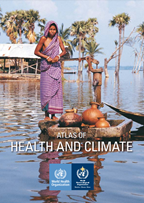
Atlas of Health and Climate
The Atlas of health and climate is a product of this unique collaboration between the meteorological and public health communities. It provides...
1 January 2008
Heat-health action plans: guidance
Climate change is leading to an increase in extreme weather events, including heat-waves. Recent heat-waves in the WHO European Region have led to a rise...
4 December 2005
Using climate to predict infectious disease epidemics
The increased accuracy of climate predictions, and improving understanding of interactions between weather and infectious disease, has motivated attempts...
All resources
All →
29 September 2021
Quality criteria for the evaluation of climate-informed early warning systems for infectious diseases
The frequency of infectious disease epidemics is increasing, and the role of the health sector in the management of epidemics is crucial in terms...
This report provides a vital snapshot of the overall progress that governments have made in the field of health and climate change to date, as well as...
24 October 2012
Atlas of Health and Climate
The Atlas of health and climate is a product of this unique collaboration between the meteorological and public health communities. It provides...
EuroHEAT, a project coordinated by the WHO Regional Office for Europe and co-funded by the European Commission (EC) DirectorateGeneral for Health and Consumers...
1 January 2008
Heat-health action plans: guidance
Climate change is leading to an increase in extreme weather events, including heat-waves. Recent heat-waves in the WHO European Region have led to a rise...
4 December 2005
Using climate to predict infectious disease epidemics
The increased accuracy of climate predictions, and improving understanding of interactions between weather and infectious disease, has motivated attempts...
8 December 2004
Heat-waves: risks and responses
High air temperatures can affect human health and lead to additional deaths even under current climatic conditions. Heat waves occur infrequently in Europe...
Early Warning and Response System (EWARS)
The WHO Climate Change and Health Unit is supporting countries to implement the Early Warning and Response System (EWARS), a predictive model developed by the University of Gothenburg in collaboration with the University of Umea and WHO Special Programme for Research and Training in Tropical Diseases (TDR). A web-based EWARS dashboard has been developed to use this model to predict outbreaks of dengue, chikungunya, zika, and in some cases, malaria and cholera. This is a user-friendly tool that can: (i) analyse and draw conclusions from historic dengue, chikungunya and Zika datasets (and is being piloted with cholera and malaria in some countries); (ii) identify appropriate alarm indicators that can sensitively and specifically predict forthcoming outbreaks at smaller spatial scales; and (iii) use these results and analyses to build an early warning system to detect outbreaks in real-time and respond accordingly. Several tools have been developed to support implement:
- A series of videos have been developed to guide you through the use of the EWARS tool for climate-sensitive diseases.
- The user manual provides step-by-step instructions to implement EWARS, including organizing your data, using the software, and analysing and interpreting results.